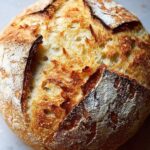
Description
This homemade sourdough bread recipe guides you step-by-step through creating a crusty, golden loaf with a light, airy crumb using simple ingredients and traditional techniques. With only about 25 minutes of hands-on work and a long, natural fermentation, this recipe yields artisan-quality bread perfectly suited for beginners and seasoned bakers alike. It uses a Dutch oven baking method for excellent oven spring and crust development.
Ingredients
Scale
Starter and Liquid
- 50 – 100 g (1/4 – 1/2 cup) bubbly, active sourdough starter (100 g recommended)
- 375 g (1 1/2 cups plus 1 tbsp) warm water, or more as needed
Dry Ingredients
- 500 g (4 cups plus 2 tbsp) bread flour
- 9 to 12 g (1.5 – 2.5 teaspoons) fine sea salt (Baleine Fine brand recommended)
Instructions
- Mix Starter and Water: Whisk the active starter and warm water together in a large bowl using a fork or spatula until combined.
- Add Flour and Salt: Add the bread flour and fine sea salt to the bowl. Mix until combined, finishing by hand if necessary to form a rough dough. Cover with a damp towel and let rest for 30 minutes.
- Stretch and Fold: After resting, stretch a corner of the dough upward and fold it toward the center. Repeat this folding 4 to 5 times around the dough. Let rest another 30 minutes, then repeat the stretch-and-fold. If possible, perform this action two more times for a total of four stretch-and-fold sessions within 2 hours to develop gluten strength.
- Bulk Fermentation: Cover the bowl with a towel and let the dough rise at room temperature (about 70°F/21°C) for 8 to 10 hours or until it increases in volume by 50%, shows bubbles on the surface, and jiggles when the bowl is moved. Timing may vary with temperature and starter amount.
- Pre-shape the Dough: Turn the dough gently onto a lightly floured surface. Fold the top down to the center, turn the dough, and repeat folding around until a round shape forms. Use a bench scraper if available to create surface tension.
- Bench Rest: Let the dough rest seam side up for 30 minutes while you prepare a proofing basket or bowl lined with a floured towel (preferably rice flour).
- Final Shape and Proof: Shape the dough again using the same folding method and place it seam side up in the prepared basket or bowl. Cover and refrigerate for 1 to 48 hours. The recommended proofing time is at least 24 hours for best crumb, but 1 hour also works.
- Preheat Oven and Dutch Oven: Place a Dutch oven inside your oven and preheat to 550°F (290°C). Cut parchment paper to fit the Dutch oven.
- Score and Transfer Dough: Remove the dough from the fridge. Place parchment over it, invert the proofing vessel to release the dough onto the parchment. Use a small knife or razor blade to score the dough surface with your desired pattern, such as a simple “X.”
- Bake Covered: Using the parchment to transfer, place the dough into the preheated Dutch oven. Lower the oven temperature to 450°F (230°C), cover with the lid, and bake for 30 minutes.
- Bake Uncovered: Remove the lid, lower the oven to 400°F (200°C), and bake an additional 10 to 15 minutes uncovered. If needed, transfer the loaf directly onto the oven rack for the last 5 to 10 minutes to crisp the crust further.
- Cool: Remove the bread and cool completely on a wire rack for 1 hour before slicing to set the crumb and finish baking internally.
- Storage: Store the bread at room temperature in an airtight container or plastic bag for up to 3 days, or freeze for longer storage.
Notes
- This recipe requires an active sourdough starter; reputable sources for starters include King Arthur Flour and Breadtopia.
- A digital scale is highly recommended for accurate measurement of ingredients.
- Flour sack towels and rice flour are ideal for proofing to prevent sticking without burning in the oven.
- Hydration can be adjusted slightly; 380 g water can yield a higher hydration dough for a more open crumb.
- Fine sea salt and kosher salt (Diamond Crystal brand) both work well; use 12 g salt if choosing kosher salt.
- If desiring inclusions like herbs, cheese or jalapeños, add before the third stretch and fold and perform an extra fold to incorporate evenly.
- Bulk fermentation timing depends on starter amount and environment temperature; watch for volume increase and dough jiggle rather than solely relying on time.
- Shaping technique affects crumb openness; shaping a batard instead of a round can open crumb more.
- A Dutch oven is essential for the baking method to trap steam and promote crust formation and oven spring.
Nutrition
- Serving Size: 1 slice (approx. 80 g)
- Calories: 210
- Sugar: 0.1 g
- Sodium: 420 mg
- Fat: 1 g
- Saturated Fat: 0.2 g
- Unsaturated Fat: 0.5 g
- Trans Fat: 0 g
- Carbohydrates: 44 g
- Fiber: 2 g
- Protein: 6 g
- Cholesterol: 0 mg